- home
- News

Latest News
January 30, 2026
Paytm is beginning to look like a profitable narrative that’s holding strong. The fintech major continued to stay in the black in Q3 FY26, buoyed by steady revenue growth, a tighter leash on expenses and key regulatory wins.
Here’s a quick look at Paytm’s Q3 FY26 results:
UPI Tide Lifts Boat: Paytm’s core payments engine continued to demonstrate its resilience in Q3. On the B2C side, the fintech major’s AI-first and retention-led approach propelled a 35% YoY surge in UPI GMV, outpacing the industry. Simultaneously, expanding device subscriptions helped widen its base of recurring revenues and strengthened its merchant footprint.
Lending Glow-Up: Beyond simple payments, Paytm continued to nudge its user base toward higher-yield financial products in Q3. The fintech major saw robust growth in merchant loans and equity broking users, with the segment reaching 7.1 Lakh active customers during the quarter. However, the company took a calibrated approach to volumes under the default loss guarantee framework, which pulled down related revenues but also lowered direct costs.
Beyond Numbers: Paytm’s board approved transferring its offline merchant business to its wholly owned subsidiary Paytm Payment Services Ltd (PPSL). It also cleared founder-CEO Vijay Shekhar Sharma’s appointment as PPSL’s MD and CEO for five years, signalling that merchant payments remain central to Paytm’s next phase.
With UPI share improving and device subscriptions climbing, the many pieces of Paytm’s profit machine are slowly coming together. While it remains to be seen whether the momentum will continue, here is how the fintech major fared in Q3.
Rising labour costs and efficiency mandates are pushing more and more factories to embrace automation and autonomous robots. Yet, the real gap is the paucity of flexible machines that can adapt to messy, real-world environments. Sakar Robotics is trying to solve this pain point.
Sakar’s 3A Approach: Founded in 2023, Pune-based Sakar Robotics is building autonomous and mobile robots that can automate linen inspection and indoor payload mobility. The startup’s robots are built around its “3A playbook” – automation, affordability and agility. Instead of a single-purpose automation, its robots are capable of doing multiple tasks and operate in unpredictable settings.
One Robot, Many Jobs: In 2025, Sakar rolled out LISA (Linen Inspection and Sorting Assistant) to automate linen quality checks at five facilities of Indian Railways. It also deployed MMR sanitation robots for biotech and manufacturing sectors, introduced its autonomous surveillance robot “Sakar Guard” at India Mobile Congress, and delivered all-terrain robots for research use cases.
What’s Next? Going forward, Sakar plans to expand LISA across railway laundries, scale MMR deployments and broaden its surveillance lineup , while being compliance-ready. As India’s industrial robotics market heads toward $3.5 Bn by 2030, can Sakar Robotics usher India into the Industry 4.0 era?

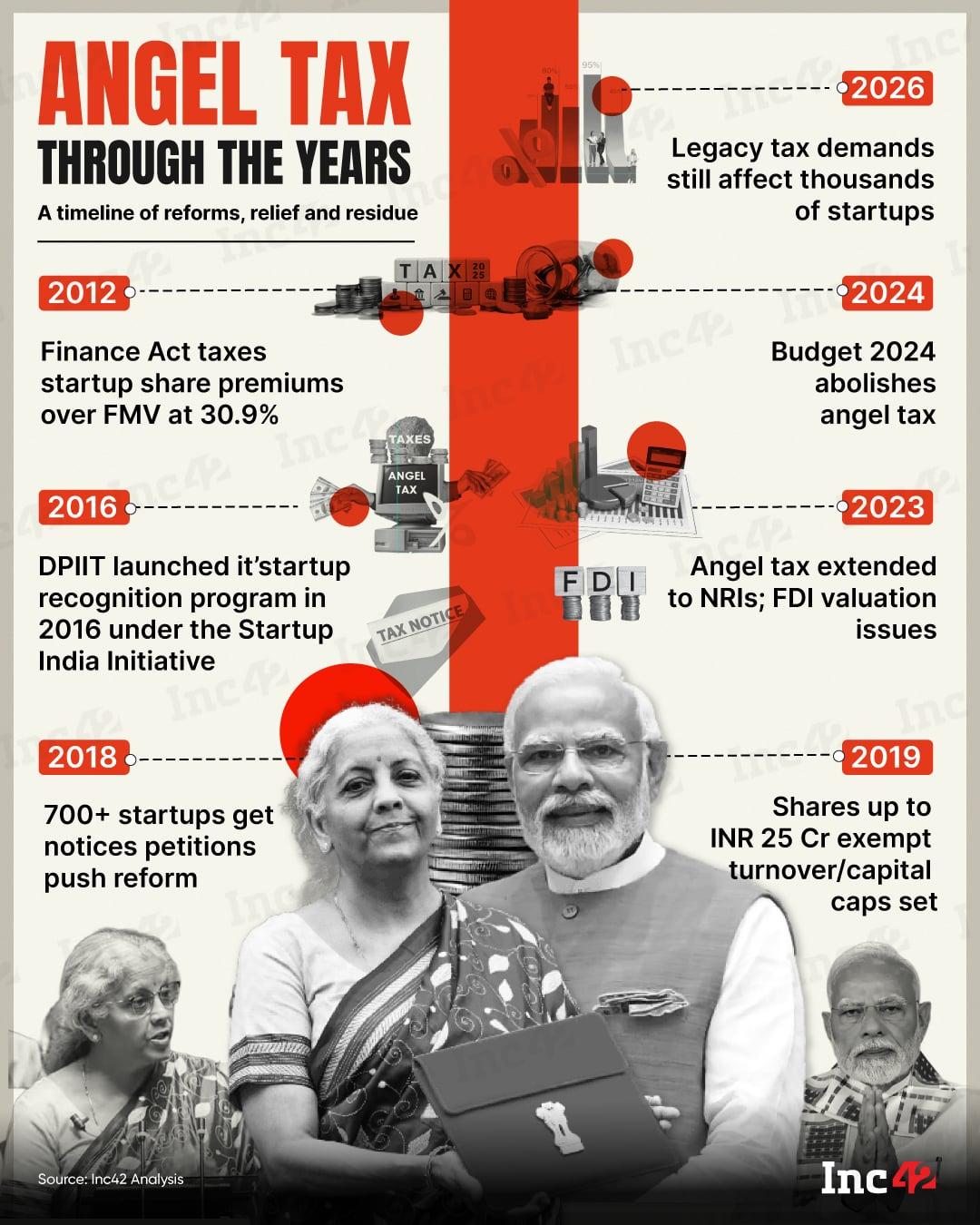
Even though Angel Tax was abolished on paper in 2024, it continues to haunt Indian founders even today. Here’s how the tax regime has evolved over the years…